
Chef’s Next Course
Acclaimed Cambridge Chef Tony Maws Starts a New Chapter Teaching Boys About Food As a Way To Connect With Each Other and The World
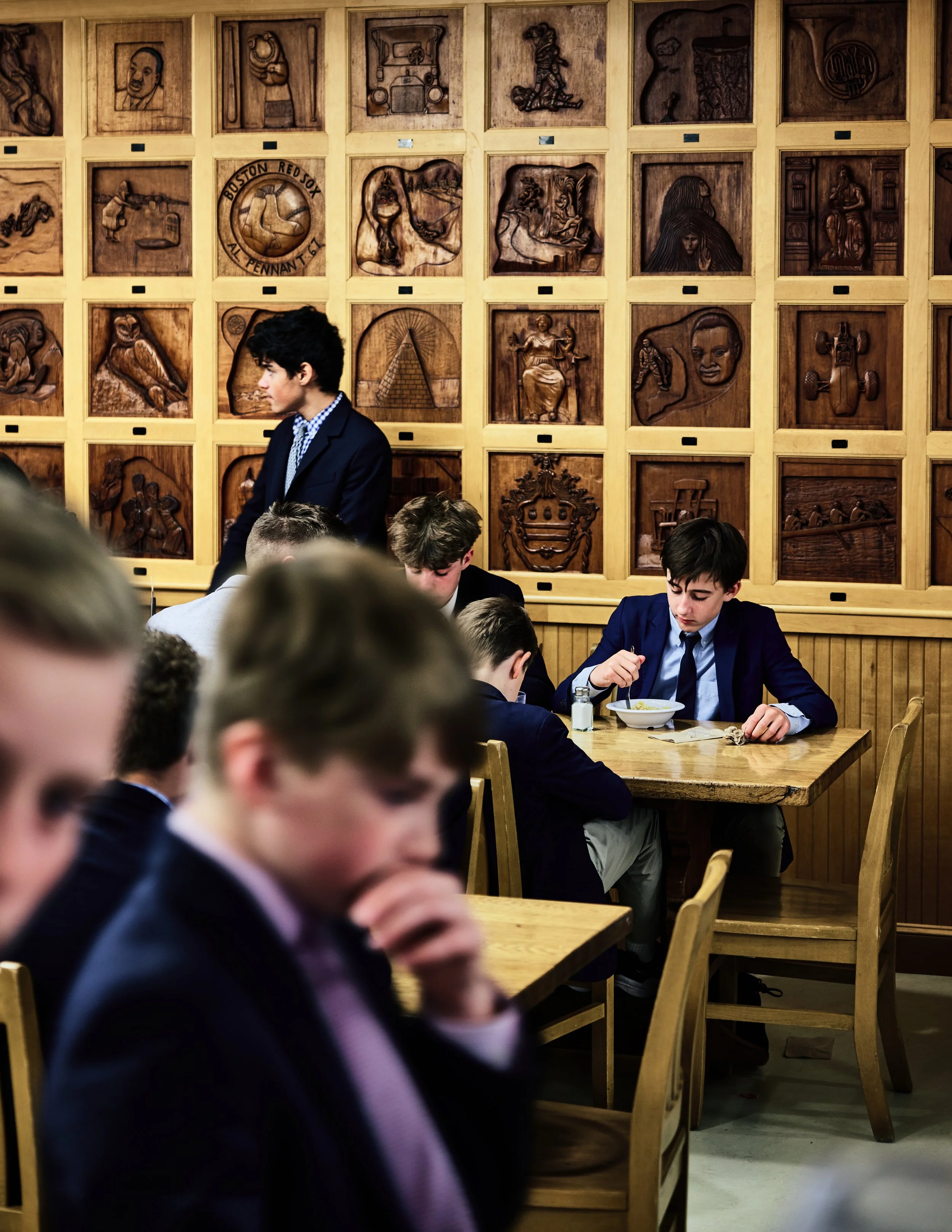

Photos by Michael Piazza
Tony Maws, the James Beard Award–winning chef and former owner of Craigie Street Bistrot and Craigie on Main, returns to his high school alma mater with a new assignment: to change how students, faculty and coaches at Belmont Hill School think about food. As an alumnus of the school (and current parent), Tony is passionate about this project emphasizing “the strong link between nutrition, physical activity and learning. It’s important that we establish that connection for our students and show them how to use food to fuel performance and promote community.”
For more than 20 years, fine diners from the Boston area flocked to Maws’ iconic restaurants, first at the Bistrot on Craigie Circle, which after five years relocated to Main Street in Central Square and then at the pandemic pop-up Craigie Next Door. While his cooking fueled the community during the pandemic years, the constant need to adapt took its toll. The food service industry was flailing. Servers, dishwashers, prep cooks and chefs were working long hours, and new protocols were rolling out daily. As he puts it, “I was on the phone with my lawyer every day trying to figure out what was happening and how to respond.” To help address these industry-wide issues, he worked with other local chefs, including Jody Adams and Ken Oringer, to establish Massachusetts Restaurants United, an organization advocating for locally and independently owned Massachusetts restaurants. Maws explains, “We cared about people and all the restaurants that didn’t have the resources we had.”
Reflecting on his own pandemic experience, Maws admits, “Business was good, but I was not a good owner of more than one restaurant. I was on pastry, prep and the meat station as well as being the chef for both restaurants. I was wearing knee braces and averaging more than 25,000 steps every day. My brain was fried, and I burnt out.” In July of 2021, Maws closed his restaurants, explaining on an Instagram post, “Shutting down Craigie Next Door (and Craigie on Main in general) at the end of July may have seemed abrupt to some of you, and I’m sorry if the announcement caught you by surprise. I’m still trying to wrap my mind around everything myself, but I am well physically and mentally, and I could not honestly say that before.”After taking some time to enjoy a more normal family life with his wife, Carolyn, and son, Charlie (now a student at Belmont Hill School), Maws started casting around for his next inspiration. He was at a crossroads thinking, “This is all I’ve ever done. If I’m not a chef, who am I? It took me a while to realize I could be something else.”
“I started talking to Alex Ong at UMass Amherst. He and his team were doing amazing stuff with food in an academic setting. They figured out how to have a conversation about food throughout campus—not just about what you are eating in the dining hall, but sports and performance, health and wellness, education. They figured out how to make food an integral part of their community. It was very powerful and effective.”
In early March of 2023, Jay Bounty, CFO and director of operations at Belmont Hill School, reached out. According to Maws, “He and some of the folks on the school’s board were aware that the food wasn’t where it should be for a school like this. So, I wrote up a vision to educate the boys on how to eat better and why. By the time the younger students are seniors, they should know what food does for them. They should know the difference between eating something that will help them in study hall or eating a candy bar that feels good for 10 minutes and then has them bouncing off the walls or crashing.” By late March, what started as a consulting proposal burgeoned into a full-time position for Maws as Belmont Hill’s director of culinary excellence, with a mission to revolutionize the school’s meal program and educate students about the power of food to nourish the mind, the body and the spirit.
Maws started by observing. “I was just standing in the kitchen watching how they fed 230 boys at each of two lunch sittings. My initial impression was that the pace was frenetic. With only 40 minutes for lunch, the boys were either anxiously awaiting their meals or wolfing them down as fast as possible. It was chaotic and that’s not what lunch is supposed to be for anybody, but especially for developing boys who are challenged here every moment of every day. They need a period they can count on to fuel themselves and take a deep breath.”
He asserts that “the most impactful thing we did in the beginning was figure out how to serve all the boys in 10 minutes or less, so they could sit down, eat something they were excited about and have a dining period where they could take time and hang out with their buddies.”
During the summer of 2023, he gutted the school’s kitchen and brought in all new equipment. He worked with the catering vendor to change the offerings, redesign the flow and elevate the menu. Maws divulges, “There was some backlash. There are kids whose primary food group is chicken nuggets and it’s hard to convince them (and sometimes their parents) that there are healthy and palatable alternatives to processed food staples. Certain things just didn’t go over well. Curry, for example. These boys hate curry.”
He chuckles, “We had to put our helmets on and deal with a mini uprising in the early days. I needed to gain their trust with open lines of communication so I started writing a weekly newsletter called The Foods Letter.” The letter is sent out on Sunday nights and it contains information about nutrition and anecdotes on the cultural aspects of food. For Maws, it demonstrates that “we can use food as a medium to talk about where other people are coming from. It’s not political—we all have to eat.” Maws is delighted that the newsletter now has an 85% open rate.
Lunch at the school now includes a composed bowl featuring a protein, a vegetable and a carbohydrate. A recent entree was a beef barbacoa burrito bowl. Students also have access to a full sandwich bar with house-roasted meats, a salad bar and a pasta station with a choice of sauces. Maws strives for continuous improvement by sending a weekly survey to all students and staff asking for feedback and suggestions. Maws’ son Charlie serves, perhaps reluctantly, as an ear to the ground—his classmates aren’t afraid to share their immediate judgments with him at the lunch table.
Improving the dining experience at Belmont Hill is only part of his mission. Maws works with teachers, coaches and student life leaders to promote healthy food choices and support community engagement. Last spring, he conducted a food demonstration with the graduating class, showing them how to beef up college- staple ramen noodles and make them into a simple and nutritious meal. He’s also done smoothie demos with the younger boys, emphasizing ingredients that will power a body through a workout or a study hall without the sugar high and the ensuing slump.
Maws also works with school affinity groups to bring diverse cuisines and cultures to the community. In the winter of 2025 he worked with a parent diversity group to host a Lunar New Year meal with longevity noodles, dumplings and Chinese meatballs. In February of the same year he collaborated with a school group to promote Black History Month by featuring African and African American dishes. In March, he offered a Passover Seder.
“One day I brought them pupusas. Next thing you know we’re talking about El Salvador and the political situation there. Another day we tasted croissants side by side. One was from a chain grocery store and another was from a local bakery. I wanted them to taste and find words other than ‘good’ or ‘bad’ to describe the experience,” says Maws. “I try to encourage them to think about food differently.”
For the spring semester of 2025, he extended his campaign to the classroom by teaching a course on food criticism. Exploring works like Kitchen Confidential by Anthony Bourdain and leveraging the popularity of food stars, Maws seeks to engage his students in a way that resonates. He says, “We’ve read Gabrielle Hamilton, Jose Andres and Matty Matheson. Matheson’s YouTube video series is pretty vulgar and funny—totally relatable for an adolescent boy.”
According to Maws, “schools like Belmont Hill are constantly evolving to attract students who perform at a high level in the classroom, on the sports fields and within the community. Food is an excellent way to enhance everything we do.” He concedes, “In my previous life, I expected satisfaction to be 100 out of 100. It was a world of perfection, but that’s not going to happen here. In some ways, it’s invigorating—and in others it’s infuriating. I am not here to make Best of Boston, James Beard Award–winning food. I’m here to feed 460 boys and gradually educate them on how to take better care of themselves and stimulate the conversations that come from food.”
This story appeared in the Fall 2025 issue.
