
Vermouth: The Hero of Summer Session Drinking
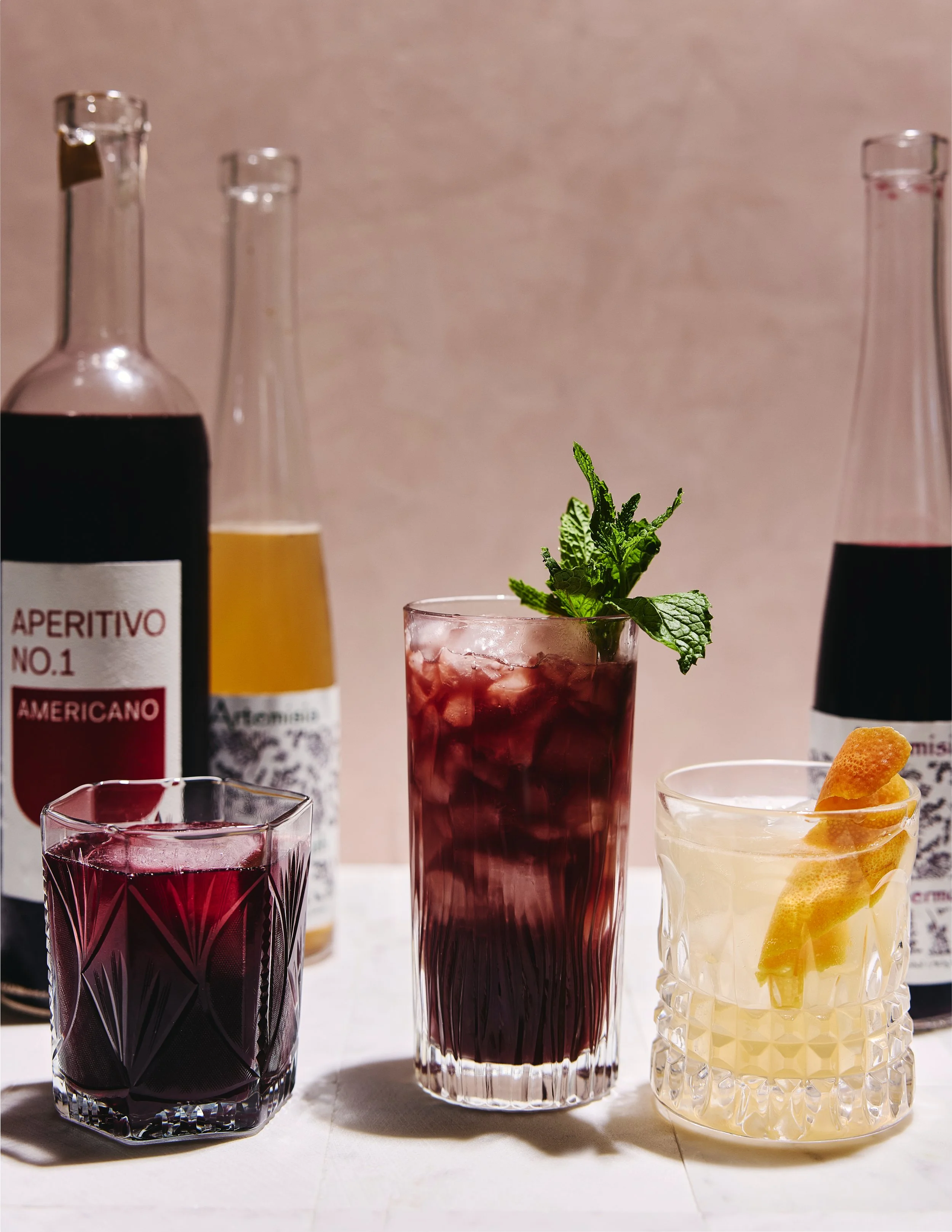
Photo by Michael Piazza / Styled by Catrine Kelty
The summer heat makes me crave longer, more refreshing drinks than I do in the cooler parts of the year. Libations with lower ABV-strength are the polar opposites of those stiff spirit-forward Old Fashioneds and Manhattans of fall and winter. When I ran the cocktail program at Loyal Nine in Cambridge, we had a “low octane” section of the menu, and I focused it on fortified wine–based recipes. One of my favorite ways to create low-alcohol drinks is to use vermouth as the star of a cocktail, not just in its typical role as an addition to a healthy slug of whiskey or gin.
Aromatized wines have been traced back millennia to several cultures including China, the Middle East and the Mediterranean. The two main reasons why people added herbs, spices, roots, barks and petals to fermented beverages were to improve mediocre wines’ flavor and also to take advantage of the plants’ medicinal properties. Whether flavor was more important than the medicinal benefits varied between cultures, but as time went on drinkers became more focused on taste and taking pleasure in these concoctions.
The current iteration of vermouth stems from Ancient Greek and Roman traditions, especially that of Absinthiatum vinum (wormwood wine), bolstered by the spice trade beginning in the 15th century with Europe’s Age of Discovery. Over time, this evolved into three traditional styles between the 1780s and 1820s—a sweet red, a dry white and a sweet white, with some more modern, bitter and alternatively flavored vermouths being released in later decades.
Vermouth was originally meant to be consumed on its own, but vermouth cocktails enter the literature in 1869 with the Vermuth [sic] Cocktail appearing in the Steward and Barkeeper’s Manual, a blend of vermouth, ice and a lemon twist, which is not too different from drinking vermouth straight (or neat). In 1882, Harry Johnson’s New & Improved Bartender’s Manual featured a Vermouth Cocktail that is more in line with the modern spelling and a more classic definition of a cocktail—with vermouth as the base, sweetened with syrup and Maraschino liqueur and modified with a dash of bitters.
While vermouth started out as a European product exported to America for the immigrant market starting in the 1830s, it was not until the 1890s when an interest in unlocking the French and Italian methods sparked domestic production. However, it was the repeal of Prohibition in 1933 that really kickstarted vermouth-making here. Sadly, the results were poor, and craft vermouths would have to wait until Andrew Quady in California released Vya Vermouth in 1999.
Vermouth made in Massachusetts may have gotten its start when cocktail bars like Eastern Standard wanted to use styles of vermouth that were unavailable here, like rosé and ambre. Mayur Subbarao, who later went on to open Amor y Amargo in Manhattan, taught an informal class on vermouths to [Eastern Standard Bar Director] Jackson Cannon and other local bartenders in 2008. It would be a few years before Massachusetts vineyards began producing it commercially, and I spoke to two local producers who go about the process in very different ways.
At Nashoba Valley Winery in Bolton, winemaker Chris Goyer learned the art of vermouth working under Paull Goodchild at Westport Rivers Winery; Westport started producing vermouths around 2014, including their Grace Prodigiosa and Field & Forest, which are still being made. Nashoba’s products were released in early 2023, a few years after Goyer had taken over the winemaking program. Goodchild’s philosophy that Goyer follows is that a lot of small amounts of spices generate a complex flavor, and each of Goyer’s vermouths is made from around 30 different botanicals. Nashoba’s sweet vermouth is made from a red wine, often Malbec or Merlot depending on what barrel is being emptied at the time, fortified with their distillery’s aged apple brandy, infused with wormwood, orange peel, cardamom, coriander, cinchona bark and other botanicals, and sweetened. Similarly, their dry vermouth uses an acidic white wine that has ranged from Seyval Blanc to Riesling, fortified by aged apple brandy and infused with wormwood, orange peel, pine needles, rosehips and other ingredients. Nashoba’s vermouths are made in five-gallon batches, and batches evolve depending on which wine varietals are on hand and the availability of certain botanicals.
The other winemaker I spoke to, Eliot Martin of the natural winery Marzae in Acton, got into vermouth through a love of amaro (Italian-style bitter liqueurs). He started playing with wine fermentation as a pandemic project in June of 2020, which piqued his interest in making vermouths. He was inspired by the Italian vermouths of Chinato Vergano and Fred Jerbis, but he wanted to feature local ingredients, including some which he later started growing himself. One of his first products, Aperitivo #1, is a vermouth in the form of Americano, a combination of a vermouth with an amaro similar to Italy’s Punt e Mes. While #1 is akin to a sweet vermouth with a touch of Campari, I had the chance to try #2 before its release, and that took things in a more root beer direction; it reminded me of a sweet vermouth with a splash of Amaro Ramazzotti. During my visit, Martin discussed a few of his other concepts, like a coastal-inspired vermouth and an Amer Blanc, a bitter white vermouth. Many of these products will be available to sample on their own and in cocktails at the Marzae Cellar & Provisions opening soon in the Boston Public Market.
With three locally produced vermouths—a sweet red, a dry white and a bitter-sweet red—I was inspired to mix up a trio of drinks that would be perfect for summer drinking. Vermouths generally fall into the 16–20% ABV range, making them just as flavorful as many spirits but at half or less the potency.
HARBOR ISLAND ICED TEA
At Loyal Nine in Cambridge, we had a low-proof section of the menu that I considered around half the strength of a liquor-based cocktail, and I often used fortified wines like vermouth, Lillet and Madeira. An early offering was the Safety Dance, made with dry and blanc vermouths, blossom oolong tea syrup, lemon juice, Peychaud’s bitters and a splash of soda water. I later did the Red Dragon that swapped the vermouth to sweet, the tea syrup to chai and the citrus to lime. I really enjoyed the way that chai tea spices work with sweet vermouth’s botanicals, so I continued in that direction here. The Harbor Island Iced Tea takes the Red Dragon concept but eliminates the need for a specialty syrup, adds in depth with local honey as a sweetener instead of sugar and brings the chai tea forward to replace the soda water to make an elegant, slightly hard iced tea.
Makes 1 cocktail
2 ounces Sweet Vermouth, such as Nashoba Valley Artemisia
2 ounces chai tea (normal steep in hot water, cooled)
½ ounce honey syrup (*)
½ ounce lemon juice
Shake with ice, strain into an Old Fashioned or highball glass, fill with ice and garnish with an orange twist. (
*) Honey syrup is equal volumes of local honey and boiling water stirred until integrated. Once bottled and kept in the refrigerator, this syrup should last at least 4 weeks.
BOLTON COOLER
The drink that converted me to a gin drinker was the Pegu Club, a recipe created in Burma (now Myanmar) in the late 19th century that made its way into famous books (like the 1930 Savoy Cocktail Book from England) which I mixed at home 20 years ago. That combination of gin, lime, orange liqueur and bitters tasted like grapefruit, and it was the first time that I witnessed such flavor alchemy in a cocktail glass. I have since tinkered with the combination in a few ways, and here I swapped in dry vermouth for the gin and elongated it with soda water to make a bitter grapefruit-noted refresher. For its name, I chose to dedicate this one to the town where Nashoba Valley Winery resides, although I could have easily gone with a fun tongue-twister based on their street: the Wattaquadock Tonic.
Makes 1 cocktail
2 ounces dry vermouth, such as Nashoba Valley Artemisia
½ ounce orange liqueur, such as Cointreau
½ ounce lime juice
½ ounce simple syrup (*)
2 dashes Angostura bitters
Shake with ice, strain into an Old Fashioned or highball glass containing 2 ounces of soda water, fill with ice and garnish with a grapefruit twist.
(*) Simple syrup is equal volumes of sugar and hot water stirred until dissolved. Once bottled and kept in the refrigerator, this syrup should last at least 3 weeks.
LANTERN HOUSE PUNCH
I have previously experimented with vermouths in tropical drinks, likes in my Torino Zombie, and Marzae’s bitter sweet vermouth seemed perfect for the genre. The first drink that popped into my head was a Jungle Bird, given the Campari-like notes; the Jungle Bird from the 1970s is Jamaican dark rum, pineapple, Campari and lime. To give it complexity, I considered a parallel drink, the Mr. Bali Hai with rums, pineapple, coffee liqueur and lemon. Since Campari and coffee notes work well together, I mashed up the concepts here. For a name, I thought about a historic tour I took of downtown Boston where Brother Cleve, the godfather of the Boston cocktail revival, pointed out the location of the four lost tropical restaurants in Chinatown, and here I pay tribute to the original name of one of those restaurants, Bob Lee’s Islander, which was the Lantern House with the Aloha Lounge inside.
Makes 1 cocktail
2 ounces bitter sweet vermouth such as Marzae Aperitivo #1 (*)
1½ ounces pineapple juice
½ ounce lemon juice
½ ounce simple syrup (**)
¼ ounce coffee liqueur
1 dash Angostura bitters
Shake with ice, strain into a decorative ceramic mug or a Collins glass, fill with crushed ice and garnish with a mint sprig. Freshly grating part of a coffee bean over the top adds an elegant, aromatic touch here.
(*) Substitute another vermouth-amaro such as Punt e Mes or use 1¾ ounces sweet vermouth plus ¼ ounce Campari.
(**) Simple syrup is equal volumes of sugar and hot water stirred until dissolved. Once bottled and kept in the refrigerator, this syrup should last at least 3 weeks.
This story appeared in the Summer 2026 issue.
