
Creating Community in Third Places
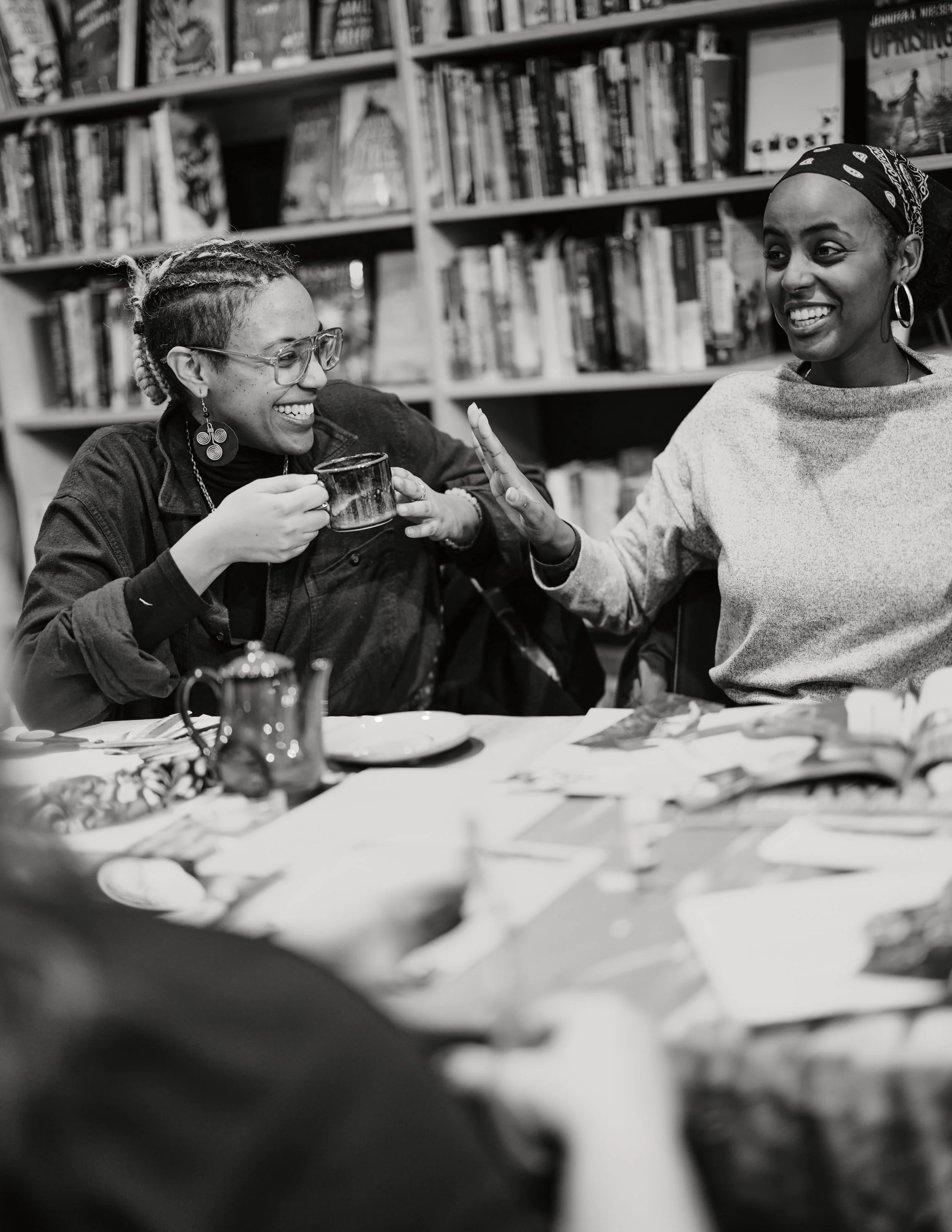
Just Bookish, Dorchester
Photos by Michael Piazza
A brewery, a wine shop, a bookstore, two farms, an apple orchard and a café: These seven places are just a few of the local businesses and organizations committed to building strong human connections in today’s individually focused, technologically driven world. They provide a “third place,” a space beyond home and work, where strangers become friends, generations learn from one another and people find education, activity and purpose. Community is embodied in everything they do: the events they hold, the food they serve, the people they hire—and even the physical spaces where they welcome their patrons.
A BREWERY AND ROASTERY
LOST SHOE BREWING AND ROASTING CO., Marlborough
At Lost Shoe Brewing and Roasting Co.’s Boozy Book Fair last November, people laughed and connected over books, sipping flights of beer and sampling freshly roasted coffees. On weekends, families play corn hole, and groups of friends settle into the comfortable leather sofas for a pint of New England IPA or a Belgian Dubbel. On weekday mornings, neighbors gather around the fireplace, catching up over unique espresso drinks, while others work remotely at tables nearby.
With a passion for coffee and beer, Melynda and JP Gallagher opened Marlborough’s Lost Shoe in 2019 to roast coffee beans and brew beer in their hometown. “We were really excited at the idea of creating this space for the community,” says Melynda, co-owner and head coffee roaster.
Seven years later, they’ve added their own brewed hard seltzer and non-alcoholic sparkling hop water to their coffee and beer options, plus grilled cheese, tater tots, soft pretzels, baked goods from Harvard Sweet Boutique in Hudson and breakfast sandwiches from Crust Bakery in Worcester. Melynda says, “We always ask ourselves if we’re not sure about doing something: ‘Is it good for our team? Is it good for our community?’ That’s really what drives us in our decision making.”
In addition to regular trivia nights, drag bingo, run club and crafts at the brewery, the Gallaghers have brought the summer farmers market back to Marlborough and added winter and spring markets, too. They’ve partnered with the mayor’s Charity Fund to start a SNAP matching program, sponsored Friday Nights Downtown, a Pride block party, spring fling, street fairs celebrating local cultures and an Oktoberfest (with two other local breweries) plus a Turkey Trot for Tots. Runners and walkers meet on Monday nights year round, and in summer, there’s free yoga just outside the brewery.
“They’re very open to collaborating and working with other businesses,” says Alyson Cox, owner of Marlborough’s Word on the Street bookstore (and collaborator on the Boozy Book Fair) . “They do so much for the community.”
“We want to give people a reason to come out and enjoy and have fun and not think about what else is happening in their lives and in the world,” Melynda says.
Wild Child, Somerville
A WINE SHOP
WILD CHILD, Somerville
There is a big table in the back room of Wild Child, a natural wine shop in Union Square, Somerville. During the day the table is covered with cookbooks, with reading and lingering encouraged. On wine club nights or during special events, the cookbooks disappear and the table—and the whole store—becomes a place for people to connect. Owner Lauren Friel says, “The wine club has become a great community builder.”
The club includes people of different generations who live within walking distance. “Wine is the catalyst,” she says, and people linger, hang out and chat with one another. “We talk about our families, what’s going on in the neighborhood and what’s going on globally.”
Friel also owns Rebel Rebel, an intimate space in Bow Market where it’s easy to meet your neighbor at the elbow-to-elbow wine bar, and Dear Annie, a Cambridge restaurant with a few small tables and one big long one to encourage connection between groups. “I’ve seen people start chatting with the people they’ve been seated next to,” Friel says. Both Dear Annie and Wild Child were born during Covid and purposely created to provide a space for connection.
Friel collaborates with small, sustainable businesses when sourcing food and wine, and supports local nonprofit organizations as well. She organizes an annual collection drive for the Cambridge YWCA to provide gifts for unhoused women and last fall took people on a field trip to a grocery store and a nearby community fridge to learn about and provide mutual aid.
“I really do believe that a very strong local community can solve a lot of our social ills,” says Friel.
A BOOKSTORE
JUST BOOK-ISH, Dorchester
Bookshelves line the walls, divide the room and encircle a table at a bookstore in Dorchester’s Fields Corner where you can get a cup of coffee and a scone or a beer and an empanada at the small bar. When an event happens, which is often, the centrally located bookshelves are wheeled out of the way and space is created for the community at Just Book-ish.
For over three years, Bing Broderick and Porsha Olayiwola, both with experience in community space and both residents of Dorchester, brainstormed about what they could contribute to their neighborhood without competing with another local business. When they learned that a bookstore had existed in Fields Corner 35 years before, “We looked at each other and said, ‘That’s it,’” says Broderick.
With support and funding from the community, the bookstore opened in November 2024, its motto evident in the books on the shelves, the food and drink they sell and the programming they offer: “culturally curated, radically influenced, locally inspired.”
“We talked about books being an incredible source for people to swap stories,” Olayiwola says. And they had to have food. “A bar is an entity by which community is organically created,” says Olayiwola. So they worked with designers to create a bar to complement the space without taking it over.
All food and drink is sourced intentionally, according to Just Book-ish’s culinary director, Tamika Francis, with South African wines, locally brewed beer, Equal Exchange coffee and Rhode Island–based black tea on the menu. The Colombian-style Magic Empanadas are made at CommonWealth Kitchen, the cupcakes are from Sugar Bakery in West Roxbury and other baked goods are sourced from Roxbury’s Nubian Markets. Every month this year they will offer a different hand pie from a different global region made by a local maker, Francis says.
In addition to the books on the shelves and the food at the bar, Just Book-ish offers events through Words as Worlds, the nonprofit that owns the bookstore. There are talks by local authors, lectures, live music, poetry slams, film screenings, writing workshops, book launches and culinary events. Book clubs meet there, students are tutored and podcasts are recorded, there’s a meet-up crossword club and some people just come to hang out. “Events are a way to develop community,” Olayiwola says.
TWO FARMS
WRIGHT-LOCKE FARM, Winchester
Hundreds of volunteers, from high schoolers to retirees, put in thousands of hours of work at Wright-Locke Farm in Winchester where, “You can get involved, you can volunteer, you can shop, you can just come enjoy the property and have a cup of coffee,” says Tracy Kinsey, communications/ outreach coordinator of Wright-Locke Farm.
When the historic 1638 farm was threatened by development in 2007, the Winchester community raised enough funds to purchase the property. Wright-Locke Farm Conservancy was formed and in 2008 began operating the farm with a mission to “build broad community” and a vision “to provide increased value for all to enjoy.”
“Community is core,” says Kinsey. “It’s the most fundamental reason we exist.”
“The farm is a big asset to the community,” says Terry Donovan, who lives nearby and was one of the farm’s first volunteers. Donovan says he has met other volunteers from neighboring towns like Arlington, Winchester, Waltham, Watertown and Medford while harvesting raspberries, weeding violets and helping to care for the chickens.
The Conservancy collaborates with local schools and community education departments, offering school enrichment programs plus nature walks, cooking classes, yoga, afternoon teas for seniors, concerts and lectures. The farm is also a local food hub, Kinsey says, selling products from local growers and makers.
“We wouldn’t survive without the community. We’re here for the community and they’re here for us,” she says.
LAND’S SAKE FARM, Weston
With a mission to connect people to the land, to build community and to inspire lifelong stewardship, Land’s Sake Farm offers membership for people in Weston and surrounding towns with CSA options, volunteer opportunities, hands-on education for all ages and special events, according to Emily Lewis, community engagement associate.
Volunteers play an essential role at Land’s Sake, Lewis says, with 2,407 people contributing over 4,700 hours of service last year, weeding, harvesting and gleaning, some in exchange for a full CSA share.
“Our CSA workshare program is a core community-building initiative and was essential in enabling the farm to grow and harvest over 200,000 pounds of produce in 2025.” While Land’s Sake produce is available at the farmstand, along with food from other local farms and producers, the farm donates 30% of its crop to hunger-relief partners throughout the Greater Boston area.
Founded by community members who believed in sustainable public land stewardship, “The organization grew out of a successful grassroots effort to protect the 40-acre Case Field from development in the early 1980s,” according to Lewis.
“Whether through education, food access, farming or celebration, our mission ensures that the land is not just something we work, it is something we share,” Lewis says.
AN APPLE ORCHARD
OLD FROG POND FARM, Harvard
“People need community,” says Linda Hoffman, co-owner of Old Frog Pond Farm, an organic apple orchard in Harvard. “Agriculture, art and community is what we’re about.”
At Old Frog Pond Farm, people can pick apples or raspberries, find art sculptures in the woods, read poetry and share stories near a pond, play African drums and celebrate the solstice, participate in a sacred fire or meditate together.
Since the early 2000s, when Hoffman first saw the land, she and her partner, Blase Provitola, have learned a lot about apple orchards and organic farming and have opened up the farm to others to encourage community.
“People walk on the land and they feel welcome and safe. They’re inspired, they start talking and meet new people,” Hoffman says.
Hoffman adds that she and Provitola are also very involved in the organic fruit growing community. She currently mentors other organic farmers, and Old Frog Pond Farm hosts National Organic Farming Association events twice each year.
“We believe in cultivating not just the land, but also the bonds that bring us together,” according to the farm’s website. “Our events are designed to inspire creativity, foster sustainable living, and celebrate the vibrant tapestry of our local culture.”
A CAFÉ
MINARA, Cambridge
“We each felt a community need for a gathering space to celebrate arts and culture and a place to meet each other,” says Jana Amin, one of four founders of Minara, a café and community space on Huron Avenue in Cambridge. Amin says that Minara is rooted in the Muslim tradition of the majlis, the original culture salon, where people of all ages can be in community with one another, listening to stories, taking part in conversation, debating and creating.
Because food is central to Muslim hospitality and community and in order to sustain the space, Minara includes a café with flavors from all over the world. “Each of our bites and drinks have their own story,” Amin says. “We really wanted to celebrate the diversity of Muslim food traditions, from African American traditions to Palestinian traditions.”
The winter menu included hot chocolate with Moroccan spices, tahini nut granola with sumac jam and yogurt from Sophia’s Greek Pantry in Belmont, olive oil from Palestine and za’atar served with Iggy’s sourdough, plus bean pies made by Chef Darryl in Roxbury.
There are book talks, live music, neighborhood jams, artwork pop-ups, crafting every Sunday and film screenings. During the African Cup soccer finals, Minara’s menu “allowed folks to experience a little taste of Morocco and Senegal,” according to Amin. In a January workshop, participants drank meramieh (sage) tea while embroidering sage motifs and learning about the importance of foraging sage in Palestine.
Minara is a project of MIPSTERZ, a nonprofit Muslim arts and culture collective. Its name is made up, a combination of different but similar sounding Arabic and Persian words meaning lighthouse, shining light or beacon of light, according to Abbas Rattani, executive director of MIPSTERZ and one of the founders of Minara.
“It really is a space for everyone,” says Amin.
While all these “third places” have worked hard to build their own tightly knit communities through in-person, face-to-face gatherings, it’s up to each of us to attend, engage and participate in order to sustain them. In an era when people spend more and more time alone, looking inward or online, we hope you’ll support and frequent a third place community builder in your neighborhood, too.
This story appeared in the Spring 2026 issue.
