
Edible Tastings: Baguettes
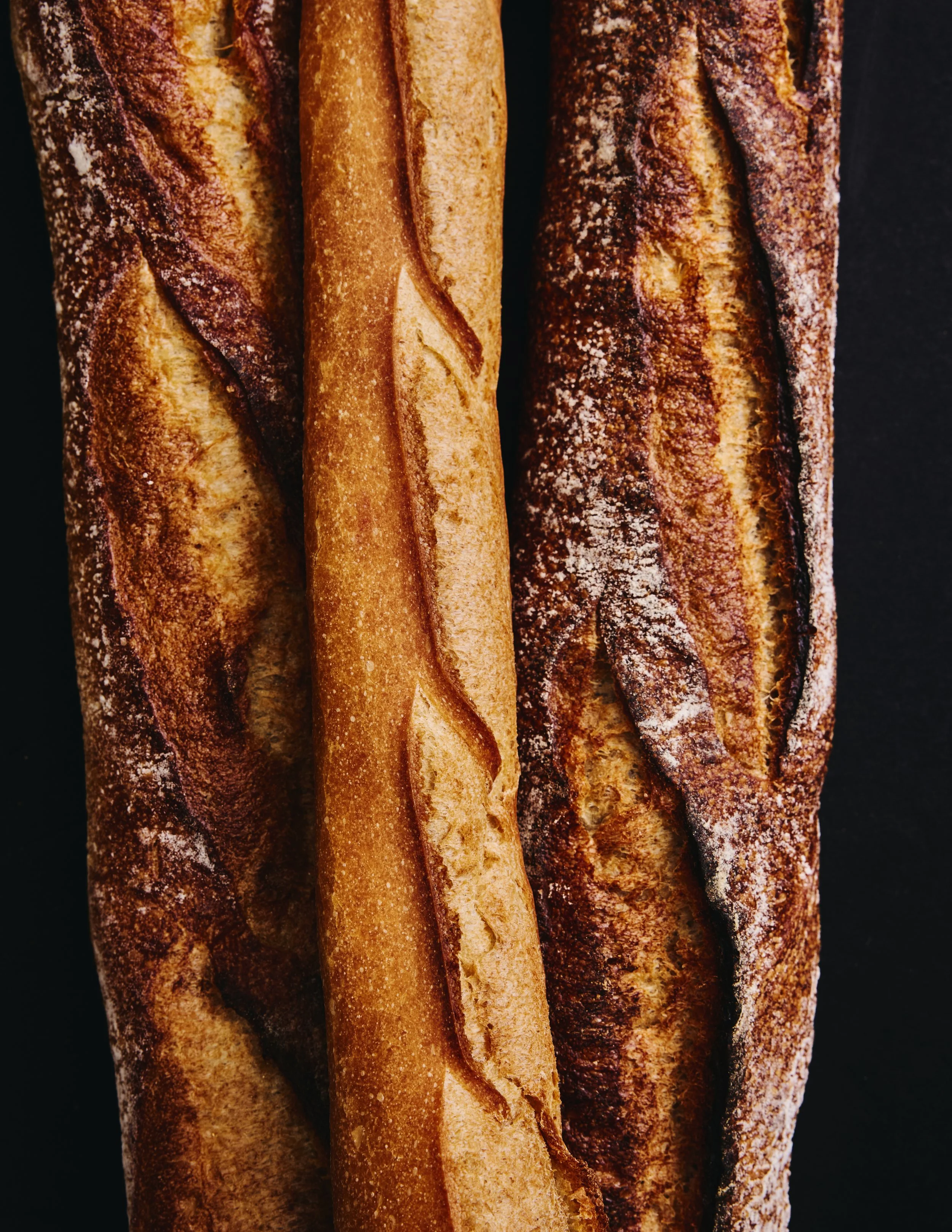
Photo by Michael Piazza
WHAT IS IT ABOUT THE BAGUETTE?
Crunchy-crusted with an airy, tender crumb, the baguette has long been a symbol of traditional French food all over the world. In countries formerly colonized by the French, baguettes have staying power: as the base for banh mì in Vietnam; as the daily bread of countries like Senegal and Algeria, where it’s estimated 49 million are eaten each day—more than the 30 million consumed daily in France itself; as well as the millions eaten in Canada, Switzerland, Belgium and elsewhere.
Baguettes may not be as ubiquitous here in the United States, but their popularity still has bakers up before dawn to turn out the long, slender loaves. Laurent Dedieu, who opened Marblehead’s Farine Bakery with his wife, Kathy, in early summer, admits a baguette might look simple, but says it’s temperamental; because of the ratio of the surface of the bread, which must be crackly and crisp, to the soft interior or mie, baguettes are much less forgiving than other breads. Kathy compares the process to poaching an egg. From finding the right flour to the long proofing time to shaping each one by hand to obtain the right balance between elasticity and strength, a baguette tests the baker’s expertise.
Nathalie Beddiar, who with her family owns Colette bakeries in the South End, Medford and Melrose, agrees the baguette is “difficult to make,” saying they take at least 24 hours from start to finish. Both Dedieu and Beddiar emphasize the importance of the flour: Dedieu mixes a special variety of King Arthur flour with one from Ground Up Grain, a stone-ground flour milled in Holyoke. Beddiar’s source is Gran Moulin de Paris, imported from France.
Dedieu, who grew up in Southwestern France where “there were no baguettes when I was a kid,” became a baker after he and his wife worked in Africa for years with Doctors Without Borders. A little more than a year ago, they resettled in Marblehead. Now his days start at 3am to bake baguettes and other breads and pastries. Their little shop is open Wednesday through Sunday from early morning until early afternoon, or “when we run out,” says Kathy, explaining that on most days almost all the items are gone by noon.
The aim at Colette, Beddiar says, is to be as much like Parisian boulangeries as possible. Hence, as is the custom there, Colette offers three types of baguettes: the French baguette in the traditional long, slender shape; campagne, a shorter loaf that contains some rye flour; and the multigrain epi loaves, shaped like sheaves of wheat. The French version, the most popular, conforms to the 1993 Bread Decree declared in France to protect this national symbol, allowing only four ingredients: white flour, yeast or levain, salt and water, with no preservatives or additives.
Despite the baguette’s historic status, there are conflicting legends about its origins. Some say Napoleon called for a bread shape easy to carry into battle; others say an Austrian baker brought the baguette to France along with the croissant. However, its popularity rose in the 1920s when finer flours and steam-injected ovens gave bakers the tools to create the baguette’s crisp crust and tender interior.
For good baguettes, Dedieu says, there are no shortcuts. The baguettes at both Farine and Colette bakeries start with a levain or sourdough starter (his is over a year old; Colette’s was started in 2020) and a very small amount of yeast. Along with good, preferably stonemilled flour, time is the most important element. “The longer you can proof the bread, the better it is,” Dedieu says. After shaping into long loaves—Dedieu’s are about 18–19 inches long—the baguettes rest for their final proof in linen cloth, and then they’re scored “for the nice look” and to release gases so that they’ll be crusty on the outside but airy inside. His oven has big, thick baking stones that accumulate heat and steam injection to ensure a crusty exterior.
Dedieu makes about 50 to 80 baguettes a day, all by hand, so as he says, each one is “unique.” In France, he says, people may visit the boulangerie several times a day, but the evening meal is typically when baguettes are served. The tradition is that the family member who goes to buy the baguette gets the first piece, often as he or she walks home. French families eat at least one baguette a day, says Beddiar, and since there are no preservatives, they last only a day or two.
American habits are much different: Although Colette bakeries sell 50 baguettes a day, the big seller is croissants, at 200 per day. But as Beddiar says, “Americans are very curious about food.”
Although we may not have the same traditions as the French, the subtleties of baguettes can win us over, and now we know a good baguette when we taste one.
Some good baguettes and where to get them:
Farine
146 Washington St., Marblehead
farinebakery.com
Colette
509 Main St., Medford
465 Main St., Melrose
517 Columbus Ave., Boston
colettebakery.com
Bonny Breads
188 Cabot St., Beverly
bonnybreads.com
Mamadou’s Artisan Bakery
63 Swanton St., Winchester
mamadous-artisan-bakery.res
Michette
164 Broadway, East Somerville
michette-bakery.com
Bread Obsession
433 Marrett Rd., Lexington
bread-obsession.com
This story appeared in the Winter 2026 issue.
