
Hanukkah Delicacies Take a Global Spin
A pair of enticing new cookbooks by award-winning authors with local ties, reflect the rich diversity in Jewish cuisine
Latkes con Mole; fried leek fritters; brisket tacos with rhubarb and kid-friendly “edible dreidels.”
These are among the Hanukkah delicacies from across the globe that take center stage in a pair of outstanding new cookbooks by award-winning authors with local ties that broaden the horizon of celebrating Hanukkah, the eight-day, beloved holiday that begins on Wednesday evening, December 25.
Sabor Judío: The Jewish Mexican Cookbook, by Ilan Stavans and Margaret E. Boyle, digs into the world of Jewish-Mexican food, a fascinating cuisine that dates back some 500 years, when Sephardic Jews fled the Spanish Inquisition.
Centuries later, Jewish refugees who fled Eastern Europe and the Holocaust added their Ashkenazi traditions and recipes.
More recently, Israelis who settled in Mexico City have opened eateries, introducing Israeli and Middle Eastern flavors.
Mexican‑born Stavans is an Amherst College professor, a New York Times bestselling author and a familiar guest on WGBH’s Boston Public Radio.
Boyle, a Jewish‑American‑Mexican who grew up in Los Angeles, is an assistant professor of romance languages at Bowdoin College, where she also directs the school’s Latin studies program. She’s a widely published writer who specializes in women’s and cultural subjects including food.
The co-authors were inspired to collaborate when they discovered that they each had inherited treasured, hand-written recipe books from their great‑grandmothers.
“The book is a labor of love, but it’s also a love letter to the Mexican‑Jewish community,” Stavans tells Edible Boston.
In A Sweet Year: Jewish Celebrations and Festive Recipes for Kids and Their Families, Joan Nathan, the award-winning, best-selling author of 12 books, invited her grandchildren into her kitchen where they chopped, stirred and ate their way through the Jewish holidays.
The delicious result is a marvelous book of recipes and menus for nine major holidays, from the Sabbath to Rosh Hashanah, Hanukkah and Passover.
A Sweet Year, embellished with stunning photographs, is an update of The Children’s Jewish Holiday Kitchen, that Nathan wrote in the mid-1980s when her three children were young.
In separate conversations, Nathan, Stavans and Boyle have each noted that Jews have carried their traditions and food with them for centuries as they fled antisemitism, sought safer havens and new economic opportunities.
As they settled in new lands across the globe, Jews from all walks of life adapted what they eat to their new locales, introducing new ingredients and flavors, often following kosher or kosher-style rules.
Just ahead of Hanukkah, Edible Boston checked in with Stavans, Boyle and Nathan for their favorite Hanukkah foods and also caught up with Ruhama Shitrit, an Israeli-born Bostonian and mother of four, who blogs about Middle Eastern and Mediterranean food.
Stavans and Boyle were in town at a recent program at Lehrhaus, the Jewish tavern and house of learning in Somerville, where master chef Noah Clickstein and the kitchen crew served up a tasting menu of selected foods from Sabor Judío.
On the tantalizing menu: melt-in-your-mouth pickled herring; fried leek fritters (often eaten for Hanukkah); latkes with mole; and a rich babka made with Somerville’s Taza Mexican-style ground chocolate filling, blending Sephardic and Ashkenazi flavors.
Lavishly photographed, Savor Judío unfolds around the table and is brimming with 100 recipes and personal stories for Jewish-Mexican-style breakfasts, more leisurely lunches and dinners.
The idea to serve latkes with chocolate mole, Mexico’s quintessential sauce, was the brilliant invention of Alison Stavans, who’s married to Ilan and is the family’s masterful cook; she learned to make mole from Ilan’s mother.
The chocolate flavor reflects the Hanukkah tradition of eating gold-wrapped chocolate coins, known as gelt.
Striking a similar chocolate theme, A Sweet Year includes a recipe for Edible Dreidels, a kid‑friendly, treat on a toothpick, assembled with marshmallows, a strawberry and a Hershey’s chocolate kiss.
Nathan shared her fondest Hanukkah memory, one that takes her back decades, when she lived and worked in Jerusalem and celebrated the first night of Hanukkah with friends.
“The menorahs were in all the windows. There were no gifts. The gift was being together, lighting candles and having stuffed vegetables,” similar to ones she included in A Sweet Year, she wrote in an email.
A savory Iraqi latke is the Shitrit family’s must-have Hanukkah dish
For as long as Ruhama Shitrit can remember, she has loved food.
“I’m a foodie in my soul,” she says.
Born and raised in Israel in an Iraqi-Jewish family, Shitrit has fond memories of the home-cooked meals that her mother prepared with fresh ingredients.
Shitrit has lived in Greater Boston for some 18 years with her husband and their four children.
During the Covid‑19 pandemic, when schools were closed, Shitrit found herself cooking throughout the day, a time when her family sat around the table together for all meals.
Shitrit had achieved a successful career as an educator. But she was ready for a change.
At the suggestion of her kids, she posted a recipe on Instagram, @ruhamasfood, her first time using the social media platform.
Her accessible, home-based recipes, inspired by Israeli and Mediterranean food, initially attracted a few followers among friends. Over time, and with excellent curating, Shitrit’s popularity on social media grew. Her Instagram site has now swelled to more than 500,000 fans.
For Hanukkah, Shitrit’s family’s go-to-food is Aruk, a savory Iraqi latke that is a staple in the Iraqi cuisine. It’s often also enjoyed on Shabbat, Shitrit says.
The crispy, herb-filled latke is served with sesame tahini and can be stuffed in a pita pocket with sumac onion and boiled egg.
Interfaith families who celebrate both Hanukkah and Christmas can check out Gingerbread Dreidels, a delightful new picture book by Jane Breskin Zalben, an award‑winning children’s author, and Illustrated by Thai Phuong. Kids will have fun baking Zalben’s original recipe for the gingerbread dreidels at the end of the book. It’s a blend of Hanukkah and Christian traditions, hugely popular holidays that coincide this year.
As family and friends celebrate during the eight nights of Hanukkah, there will be many opportunities to try these special dishes, from the traditional to the less familiar, adding flavors and aromas that reflect the rich diversity of Jewish life.
This story appeared as an Online Exclusive in December 2024.
RECIPES
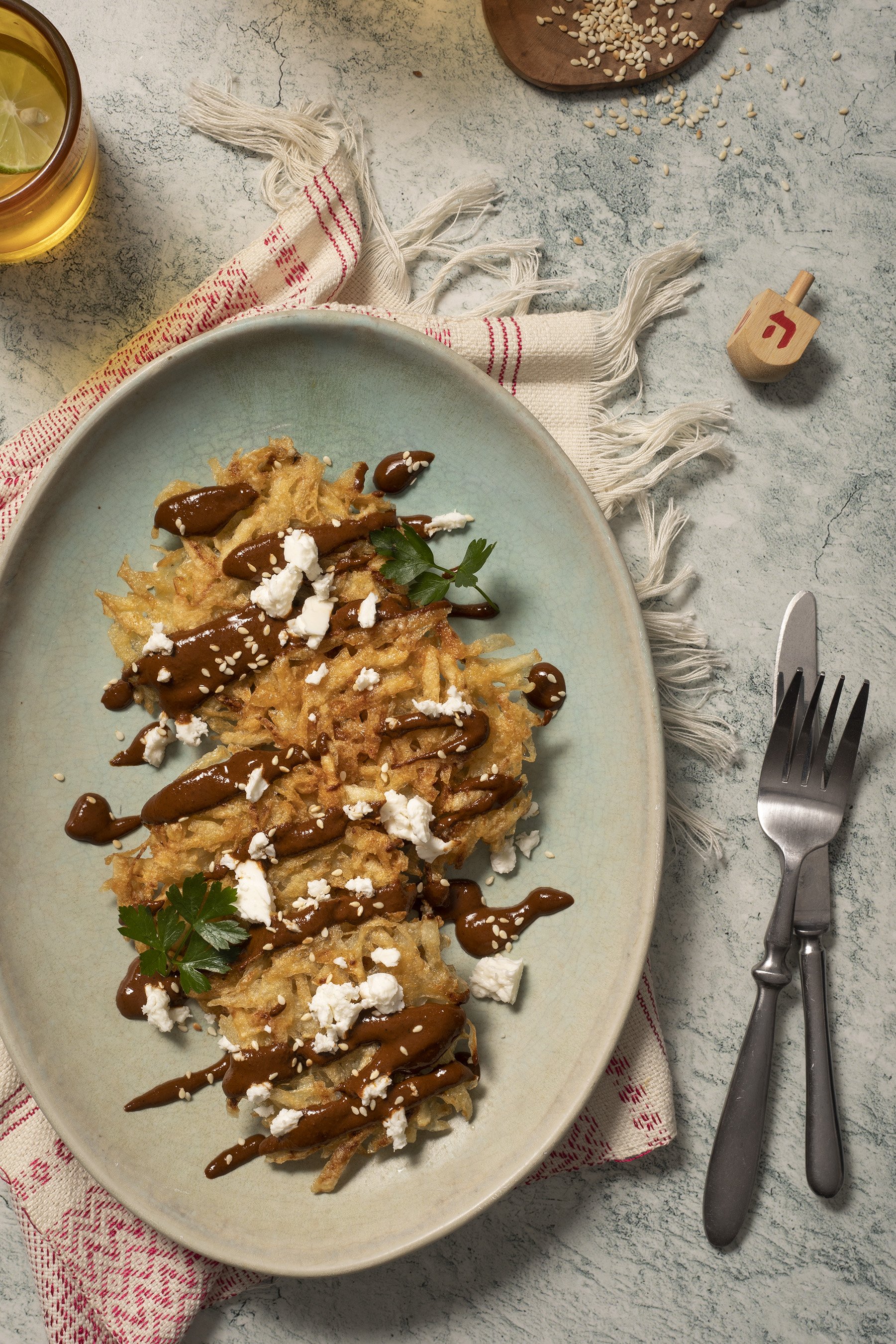
Latkes con Mole
From Sabor Judío: The Jewish Mexican Cookbook by Ilan Stavans and Margaret E. Boyle. Reprinted with permission from University of North Carolina Press (courtesy)
This delicious recipe of fried potato latkes, served with Mexican mole, was created by Alison Sparks, wife of Ilan Stavans. Years ago, when they visited Ilan’s mother, Ofelia, in Mexico, Alison learned to prepare her wonderful mole sauce. At the family’s next Hanukkah celebration, when she served homemade latkes, she surprised her family by adding Ofelia’s mole as an accompaniment, along with the traditional applesauce and sour cream. A classic was born. (From the headnote in Sabor Judio.)
Serves 8
Preparation time: 1½ hours
FOR THE LATKES
4 pounds russet potatoes, scrubbed and peeled
1 medium yellow onion, peeled
½ cup potato starch
1 tablespoon kosher salt
4 large eggs, lightly beaten
Vegetable oil, for frying
FOR THE MOLE
2 tablespoons vegetable oil
1 small white onion, finely chopped
1 (8-ounce) jar prepared mole
3 cups chicken or vegetable broth
2 ounces bittersweet chocolate, roughly chopped
FOR SERVING
Crumbled queso fresco
Make the latkes: Line 2 large baking sheets with several layers of paper towels and set aside.
Grate the potatoes and onion on the large holes of a box grater. (Or cut them into quarters and shred using the shred-ding disc of a food processor.) Working in batches, wrap the shredded potatoes and onion in a clean tea towel and squeeze out as much water as possible.
Add the shredded potatoes and onion to a large bowl along with the potato starch, salt and eggs. Mix until fully incorporated.
In a large frying pan, heat ¼ inch of oil over medium-high heat until shimmering but not smoking. Working in batches of 4–5, drop ¼ cup of batter into the pan and press gently with a spatula to flatten slightly. Cook, flipping once, until browned on both sides and cooked through, 6–8 minutes per batch, then transfer to the prepared baking sheets to drain.
Continue with the remaining latke mixture, adding more oil as necessary and adjusting the heat up or down if the latkes are browning too quickly or not quickly enough. The latkes can be kept warm in the oven while preparing the mole.
Make the mole sauce: Heat the oil in a large saucepan set over medium heat. Add the onion and cook, stirring often, until softened, 6–8 minutes.
Add a heaping tablespoon of the prepared mole, stirring to combine it with the onion, then add 1 cup of the broth. Bring to a boil, then lower the heat to medium low and cook, stirring often, until the mixture reaches the consistency of thick soup.
Continue adding the prepared mole and the remaining broth, a little at a time, until both are completely used up. Continue cooking the mixture, stirring often, until it turns into a thick, rich sauce. Add the chocolate, stirring to melt, then remove from the heat.
Serve the latkes hot, topped with mole and crumbled queso fresco.
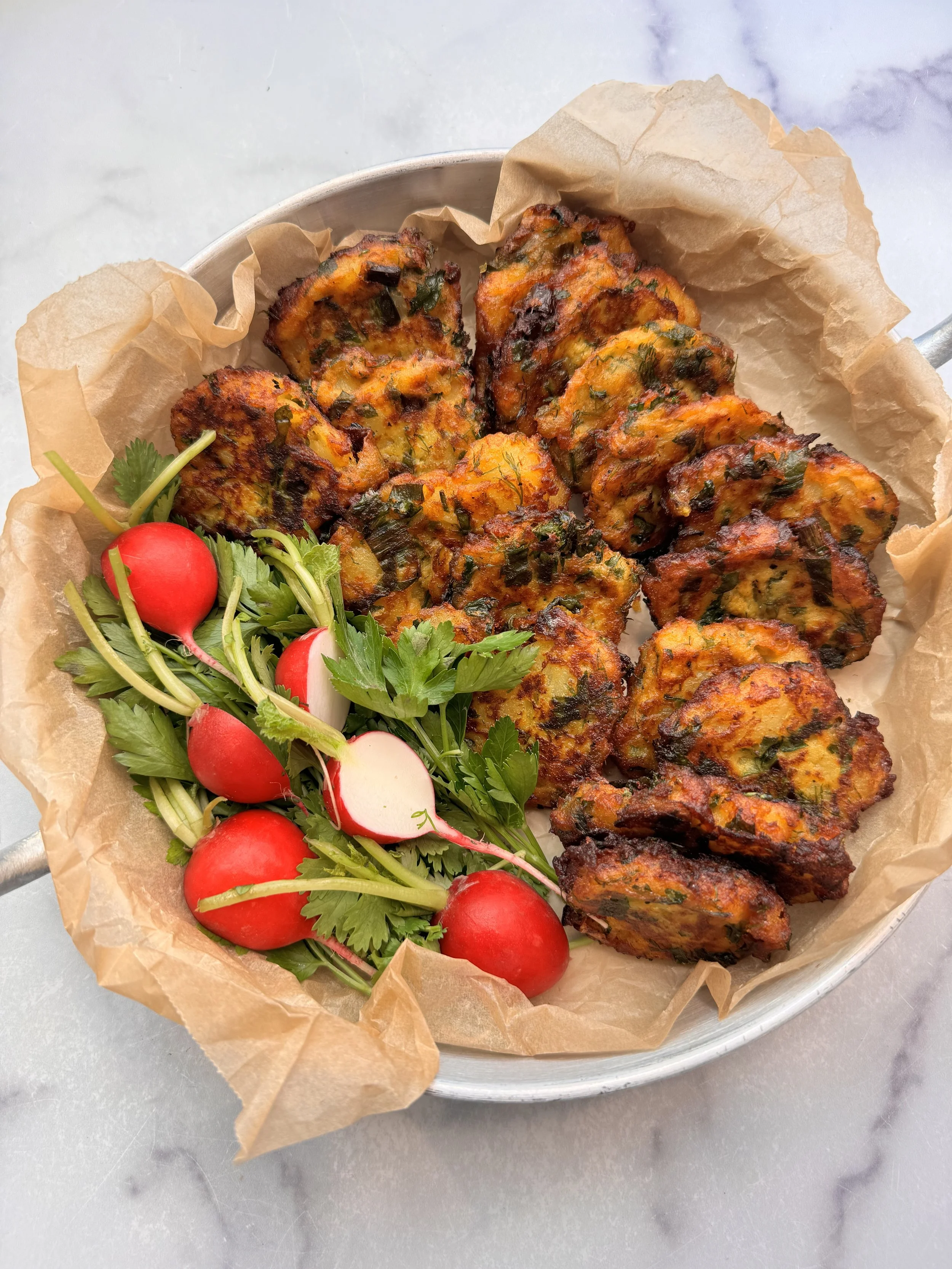
Aruk Iraqi Latkes
On the Hanukkah table at the Greater Boston home of Ruhama Shitrit where she lives with her husband and their four children, you’ll always find sizzling platters of Aruk latkes, the go-to family favorite. Shitrit was born and raised in Israel and is a popular food blogger sharing her delicious, accessible Israeli and Mediterranean recipes. Shitrit grew up in a Jewish-Iraqi family in a multicultural neighborhood of immigrants. Her mother prepared Iraqi meals made with fresh ingredients, along with recipes she learned from their neighbors. If you can’t find Baharat, you can make your own with a blend of spices used in Mediterranean cuisine including cinnamon, cardamom, cumin, coriander, turmeric, ginger and others.
Makes around 36 patties
15 small golden potatoes, peeled
5 scallions/green onions, including the green part
handful chopped parsley
handful chopped dill
1 teaspoon salt
½ teaspoon black pepper
½ teaspoon turmeric
½ teaspoon paprika
½ teaspoon garlic powder
1 teaspoon Baharat spice blend
2 eggs
2 tablespoons all-purpose flour
oil for frying, whatever type you prefer
In a large pot put the peeled potatoes with salt and cover with water. Over medium heat boil the potatoes for about 25 minutes until they start to soften. Drain and place the potatoes in a bowl.
Using a potato masher, roughly mash the potatoes so they’re still chunky. Add the rest of the ingredients and mix it all well.
Add oil to ¼-inch deep in a skillet and place over medium-high heat.
Using a tablespoon, make patties from the mixture and fry in the hot oil for 2–3 minutes each side until they are golden brown.
Arrange the Aruk patties on a platter and serve with fresh vegetables. Enjoy!
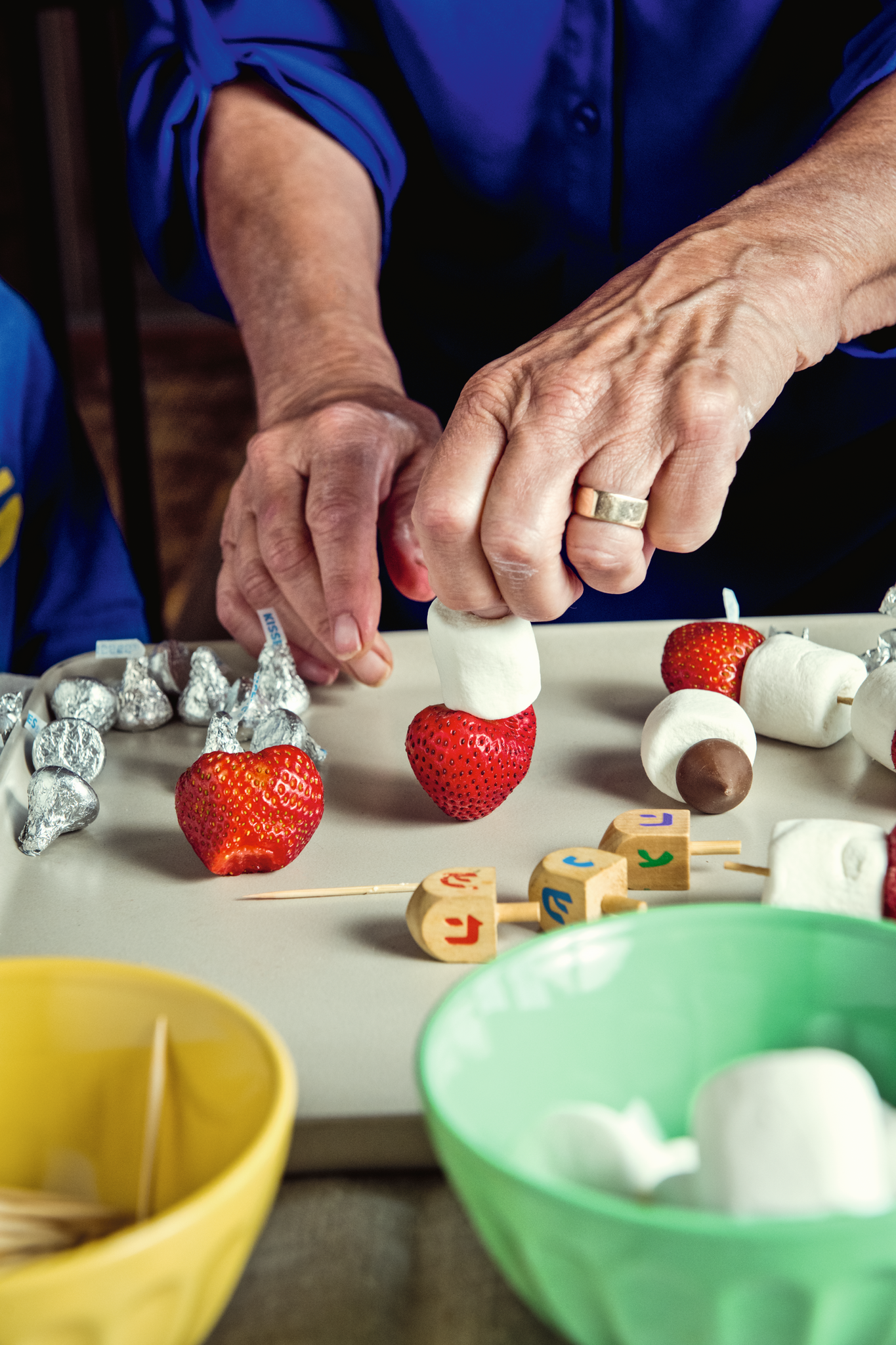
Edible Dreidels
From A Sweet Year: Jewish Celebrations and Festive Recipes for Kids and Their Families by Joan Nathan. Reprinted with permission by Alfred A. Knopf.
In this splendid, fun book by Joan Nathan, a bestselling author and New York Times food contributor, the maven of Jewish cuisine invited her grandchildren into her kitchen to cook their way through the major Jewish holidays.
In Nathan’s headnote for this recipe, she explains the tradition of playing the simple gambling dreidel game, where players spin the four-sided top that has symbolic Hebrew letters. Kids can choose to use pennies, known as gelt, or use tokens, such as dried beans, cranberries or nuts. Depending on where the top falls, you either win the full pot or have to put something in. “When the children are tired of playing dreidel, they can make an edible one,” Nathan wrote.
Makes 1
1 marshmallow
1 whole strawberry
1 Hershey’s Kiss, unwrapped
Special equipment:
Toothpicks
Dull knife
Thread a toothpick through a marshmallow. Hold the strawberry with one hand and use a dull knife to cut it with your other hand into a 1-inch drum, then thread it onto the toothpick. (Strawberries are great fruit with which to practice cutting skills.) Add the kiss to the end. Eat it, don’t spin it! Repeat to make more edible dreidels.
